Wednesday, May 25, 2011

ROP foils smuggling of banned cigarettes

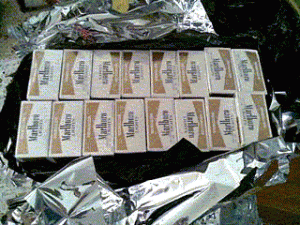
Buy cheap cigarettesIn the second operation of its kind this month, the Customs Department in Al Dhahirah foiled the smuggling of cigarettes hidden in a water tanker. The smuggler, who tried to import the cigarettes via Wadi Al Jizzi border checkpoint, used a similar technique as the earlier one.
He was found to have divided his 600-gallon tanker by a metal partition behind which he kept some 700 cartons of cigarettes that is an imitation which is banned to enter the Sultanate.
The earlier operation took place at Wadi Saa’ border checkpoint when a man was arrested smuggling banned cigarettes. The two instances of smuggling were in violation of the unified GCC Customs Law.

Tuesday, May 17, 2011

Internet and Mail-Order Cigar Sales Banned in Maryland

Internet and Mail-Order Cigar Sales Banned in MarylandBuying cigars over the Internet or by mail order is now against the law in Maryland. State lawmakers prohibited that form of sale for all tobacco products in a move intended to more effectively collect tobacco taxes in the state.

The law, called HB 88, went into effect on May 1. It was passed by the State House and Senate last year before being signed off by Governor Martin O’Malley. A bulletin from the Maryland comptroller’s office summarized the law, defining premium cigars as part of the larger “OTP” category (Other Tobacco Products), clearly stating: “The purchase and sale of OTP by mail or over the Internet is prohibited.”

The move has been controversial, and subsequent public outcry prompted Field Enforcement Division Director Jeffrey A. Kelly to release a statement on May 11 in its defense. “The intent of HB 88 was to strengthen Maryland’s ability to identify and prevent widespread occurrences of tax avoidance and smuggling of other tobacco products (OTP), which include cigars, little cigars, pipe tobacco, chewing tobacco and moist snuff. For years, contraband OTP-on which the tobacco tax has not been paid but is due-entered Maryland in a variety of manners, virtually unrestricted and unregulated.”

Kelly’s open letter also dispels any “erroneous” notions that the new law was instated to protect Maryland’s retail cigar stores.

“One reason this bill was needed is because certain retailers have purchased and sold contraband OTP illegally and the prosecution of these retailers under previous law was difficult at best.”

Kelly acknowledged the “unanticipated consequences” of the law, and its affect on Internet consumers, noting the state’s growing number of cigar-smokers and verbalizing the intention to keep their business within Maryland.

Cigar Aficionado tried on multiple occasions to contact some of Maryland’s more prominent tobacconists, but none offered comment. However, Holt’s Cigar Co., a large online and catalog business based out of Pennsylvania, did issue a very strongly worded mass email to all its customers:

“As a Maryland resident, you should be outraged,” the email says, calling the law unconstitutional, anti-freedom, anti-choice and wholly un-American. “If you live in a rural area without a cigar store within reasonable traveling distance, you are basically denied access to cigars, period.”

In a recent development, Delegate Michael Smigiel (R) told the Baltimore Sun (which has dubbed this new law “cigar gate”) that he will use the rare fall General Assembly meeting to introduce legislation ending the state’s new ban on premium cigar shipments.

The state seems to be receptive. Christine Feldmann, the Comptroller’s Deputy Director, Office of Communications told Cigar Aficionado that the Comptroller’s Office intends to work with the Maryland General Assembly on a legislative remedy for this issue “that would address the need for tax fairness while allowing consumers more choice. This issue is surely not over,” she said.

Thursday, May 12, 2011

Kingston’s Edie Adams made smoking sexy and fashionable in the ’50s and ’60s

Kingston’s Edie Adams made smoking sexy and fashionable in the ’50s and ’60sFor more than a decade, Edie Adams appeared in magazine ads and television commercials as the pitch-lady for Muriel cigars. Clad in a sequined, low-cut dress, the blonde temptress taunted men with her scintillating come-on line, “Why don’t you pick one up and smoke it sometime?” More popular was the commercial in which Adams pitched the 10-cent cigars by breathily singing, “Hey, big spender, spend a little dime with me.”

At a time when consumerism was booming across the nation, the advertising industry persuaded Americans to purchase new products as a sign of status. Smoking was considered “sexy” and “fashionable,” and the sensual Adams used television to propel her career as a singer, Broadway, television and film actress and comedienne.

Born on April 16, 1927 in Kingston, Edith Elizabeth Enke was the daughter of Sheldon and Ada Adams Enke. The family relocated to Grove City and eventually to Tenafly, N.J., where Edie finished high school. Her mother taught her to sing and play the piano and she refined these talents as a youngster with the Grove City Presbyterian Church choir.

Edie’s passion for music inspired her to earn a vocal degree from the Julliard School of Music before matriculating to the Columbia School of Drama. She also studied at the Actor’s Studio in New York and the Traphagen School of Fashion Design, where she became adept at designing and sewing.

Uncertain about pursuing a career in fashion design or music, Adams cast her fate to serendipity. She solidified her singing reputation on the nightclub circuit and appearing in such stage shows as “Blithe Spirit” and “Goodnight Ladies.”

In 1950, she won the “Miss U.S. Television” beauty contest, which led to an appearance on the Milton Berle Show. Adams’ big break came shortly after when she appeared on Arthur Godfrey’s Talent Scouts. Although she didn’t win the contest, she was discovered by the producer of the Philadelphia-based Ernie Kovacs Comedy Show. The producer envisioned her as a seductive “straight man” who could mesh well with the zany comedian.

Adams began working regularly in television with Kovacs, who was outrageously funny. The show, which was live and unrehearsed, was groundbreaking in the new medium of television.

Edie developed an exceptional talent for impressions, imitating celebrities like Marilyn Monroe, Mae West and Zsa Zsa Gabor. The duo performed such hilarious skits as “Ernie in Kovacsland” (1951) and “Kovacs on the Korner” (1952). But the show was short-lived, being too progressive for mainstream audiences.

Kovacs and Adams married on Sept. 12, 1954 and became a popular couple in the Hollywood social circuit in the late 1950s. The husband-wife team revived their careers in a comedy series, winning Emmy nominations for best performances in 1957. In 1960, the duo portrayed themselves as the guest stars in the final Lucille Ball-Desi Arnaz hour-long TV special.

After Kovacs was killed in a 1962 car accident, Adams was left with his significant gambling debts. Instead of filing bankruptcy, however, she worked her way out of debt and, in the process, her career received a second wind.

She returned to the nightclub circuit, recorded albums and toured the country in various dramatic and musical comedy vehicles including “Rain” (as Sadie Thompson), “Bell’s Are Ringing,” “Annie Get Your Gun” (as Annie Oakley), “I Do! I Do!”, “Anything Goes” and “Bus Stop.”

Adams also played supporting roles in several films, including the bitter secretary of two-timing Fred MacMurray in the Oscar-winning film The Apartment (1960) and the wife of presidential candidate Cliff Robertson in 1964′s The Best Man.

More than anything, however, Adams was known for pitching Muriel cigars to television audiences. In the 1950s and 1960s, cigarette smoking was extremely fashionable. Americans considered the practice “cool” because almost everyone in the public eye smoked, including sports figures, movie stars and singers. And with the popularity of television, viewers in the 1950s and 1960s routinely witnessed their heroes lighting-up. Tobacco companies mounted effective ad campaigns for their products, too. There were “singing cigarettes,” “dancing cigarettes,” movie stars pitching cigarettes, and even actors portraying doctors who promoted the “benefits” of cheap cigarettes in television commercials.

The makers of Muriel cigars cashed in on the craze by employing Edie Adams’ star power during the 1950s and 1960s. Considering that her late husband had been a notorious cigar smoker, who at one time sold Dutch Master cigars on TV, the idea of Edie pitching a slimmer cigar on television was only natural. Dressed in sexy attire, the blonde beauty impersonated the sensual stereotype of Marilyn Monroe. With a wink and a smile, she cooed one of her trademark cigar slogans while holding a box of Muriels in hand. The commercials were smashingly successful and highly profitable. What’s more, Edie made sure that she exercised her influence on the direction of the advertisements, providing them with a perfect blend of class, glamour and sensuality.

While growing noticeably heavier in later years, Adams never lost her trademark humor and sex appeal. She made occasional stage appearances in such shows as “The Best Little Whorehouse in Texas,” the female version of “The Odd Couple,” “Hello, Dolly!” and “Nunsense.” She also started her own cosmetic and beauty salon businesses.

Edie had two later marriages, briefly to photographer Martin Mills and then to trumpeter Pete Candoli. She gave birth to two children: a daughter, Mia Susan Kovacs, who was born in 1959 and killed in an automobile accident in 1982, and a son, Joshua Mills.

Because of her 20 years of commercials for Muriel cigars and her successful business ventures, Adams went from being mired in debt after Kovacs’ fatal accident in 1962 to being a millionaire in 1989. Suffering from cancer and losing weight in recent years, Adams died of complications from pneumonia at age 81 in Los Angeles on Oct. 15, 2008.

Thursday, April 14, 2011

Smoking allowed: Cigar bars offer a safe haven

Cigars allowedSometimes a cigar is just a cigar. But finding a place to enjoy it? Good luck with that, pal. Yet, there are still dens of iniquity where the words “smoking” and “allowed” are linked, when a guy or girl can fire up their choice of legal intoxicant from Honduras or the Dominican Republic. Smoking a cigar is a ritual, a way to slow down. And it keeps both hands busy, so the devil can’t find work for them. Here, we offer a round-up of safehouses where you can light up without censure.

From the outside, Executive Cigars in the North Side looks like a neighborhood smoke shop that would specialize in those commercial cigars sold in small cardboard boxes.

Don’t be fooled.

The two-year-old store run by Andrew Lee is home to a sealed room filled with floor-to-ceiling racks of cigars ranging from $5 to $30 each. They represent offerings from companies such as Oliva and offer a great variety of cigar types, tastes and sizes.

Lee tries to offer a cigar education to his customers, insisting “if you know the rules of math you can solve any problem. If you are going to smoke cigars you have to know the rules.”

The shop may have an urban appearance, but customers talk about its range of clients, from neighbors to young professionals on their way home to the suburbs.

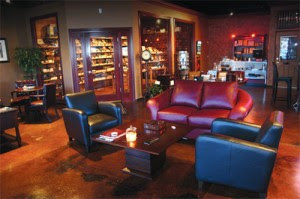
Besides the smoke-selection room, Executive Cigars also features a lounge area behind it with flat-screen TVs, leather couches and chairs and a bar. Drinks are not sold, but are available to members who bring their own bottles and also contribute to a drink fund.

Memberships range from $30 to $75 a month, Lee says.

There also is a party room upstairs that was the site of a Super Bowl get-together and is a spill-over site when the lounge gets full. It still is developing, but already is decorated and furnished.

Lee says one of the more unusual aspects of the shop is its late-night nature. He says its unofficial motto is “Your late-night cigar store,” and is generally open at least until 1 a.m.

Tuesday, April 12, 2011

Japan Tobacco Staggers Back Following Quake

Japan TobaccoSENDAI, Japan—As shops slowly reopen along Japan’s tsunami-hit northeastern coast, many residents still aren’t finding one of the Japan markproducts they crave most: cigarettes.

The shortages represent the latest supply-chain breakdown in Japan—and a headache for Japan Tobacco Inc., which for decades has dominated Japan’s tobacco market.

The March 11 earthquake and tsunami knocked out two of Japan Tobacco’s six cigarette-making factories, damaged its distribution network and wrecked some of its suppliers’ facilities.

Japan Tobacco was forced to halt deliveries across the whole country for 12 days starting March 30. Although it said it expects to restart deliveries of seven top brands on Monday, the move cut supplies to millions of smokers, forcing even the company’s most loyal customers to try cigarettes from international rivals British American Tobacco PLC and Philip Morris International Inc.

Most of the Japanese company’s other 97 products won’t be available for weeks, if not months. The company said it aims to restart deliveries of up to 25 products over the coming month and return to normal supply volume capacity by the end of June.

Japan Tobacco’s ability to restore full capacity quickly could determine whether it can hold on to its 65% share of the $40 billion Japanese cigarette market, analysts and people in the industry said. “This could change the market and put the imported brands on top” for the first time, said Yasuhide Kitagawa, whose family runs Sendai’s Panda drug store, which specializes in foreign brands and markets BAT brands heavily. “We want that to happen.”

Taizo Demura, an analyst at Morgan Stanley MUFG Research Japan, estimated that Japan Tobacco would lose one to six percentage points in market share. “Some consumers will change,” he said. “They will try Kent, Lark, Virginia Slims or Marlboro as a trial and if they think it is better than JT, then they will stay.”

In addition to losing two of its factories, a Japan Tobacco distribution center in Sendai was damaged. The company also has had problems getting such supplies as the cardboard for cartons, the fluff in cigarette filters and the plastic film used to wrap packages, said Hideyuki Yamamoto, general manager of media and investor relations for Japan Tobacco. Among the first seven brands of which Japan Tobacco will resume distribution this week: Seven Stars, Mild Seven and Caster.

The struggle to deliver cigarettes is the latest bit of bad news for the industry in Japan. Like many countries, it has been ratcheting up taxes and restrictions, and the percentage of Japanese people who smoke slid to 25% in 2009 from 33% in 2000, according to Japan Tobacco.

While delivery of foreign brands in Japan’s northeast also was interrupted by damage to distribution centers, output was unaffected because those companies’ cigarettes are made outside the country. Foreign companies aren’t allowed to make cigarettes in Japan. Even though the foreign companies largely have resolved their distribution problems, domestic and foreign cigarettes brands alike have been hoarded by smokers worried over consistent supplies.

Smokers in Sendai exchanged tips on which stores still had supplies. Some smokers had friends and relatives courier cartons from other parts of Japan. Men took drags on the long, thin cigarettes that are marketed to women. One shop had a five-page list of orders.

Loft tobacco shop, which was the last supplier in its neighborhood, had only international cigarettes. “JT Sold Out,” said a hand-written sign on its window. “I will smoke whatever they have,” said Aika Ono as she stood in the long line in front of the store.

BAT and Philip Morris said they don’t intend to take advantage of Japan Tobacco’s situation. But they are increasing shipments to the country to meet customer demand. BAT has doubled its inventory to about four billion cigarettes. It has even airlifted cigarettes and routed supplies through Kobe to avoid bottlenecks in Tokyo.

Still, some analysts and investors projected that Japan Tobacco will offer its full portfolio within months. And some customers may feel it is their duty to switch to one of the few available Japan Tobacco brands rather than to foreign labels.

“While it is not as patriotic a mood as the ‘Buy America’ sentiment in the wake of 9/11, there could be a Buy Japan’ movement among smokers after the 3/11 earthquake,” said Chris Redl, chief investment adviser of Siena Capital, a Japan-dedicated hedge fund.

Monday, April 4, 2011

Debate fumes as Sydney apartments stub out smoking

Debate fumes as Sydney apartments stub out smokingAn Australian apartment block which has banned residents from smoking in their homes has sparked anger from civil libertarians but advocates say it could be the way of the future for high-density living.

Owners of the apartments in Sydney’s inner western suburb of Ashfield agreed to introduce a by-law which bars anyone smoking inside their flats or on their balconies, the Sydney Morning Herald reported Saturday.

“We’ve made it a smoke-free zone in its entirety,” chairman of the owners’ corporate body Alex Antic told the paper.
Advertisement: Story continues below

The move came about after some residents of the late 1960s building had complained about smoke drifting into their apartments from vents in the ceiling or from neighbours lighting up on their balconies.

“In addition, we had constant problems with cigarette butts all over the garden and footpath,” Antic said.

“So we asked our managers if we could have a by-law to ban all smoking in units as well as on common property and two weeks later they came back with a draft of a by-law to make the building a smoke-free zone in its entirety.”

Owners then accepted the proposal at an annual meeting, the paper said.

While those in real estate and apartment management said non-smoking residences could become more popular in high-density cities, civil libertarians labelled the move outrageous.

“You can’t ban the use of a lawful product in someone’s own home,” said New South Wales Council for Civil Liberties president Cameron Murphy.

“The next thing is they’ll be banning the drinking of coffee.”

Tuesday, March 29, 2011

Phone Text messages Used as Smoking Cessation tool

Smoking cigaretteText messages could become a vital smoking cessation tool, research carried out by multiple US universities has indicated. Because cell phones are now such a regular feature of our everyday lives –and because many people possess phone deals that give them unlimited text messaging – the researchers argue that text messages can be used as a cheap and convenient method of amassing data about Doina smoking habits.

They say that by encouraging smokers to send a few texts each day which detail their smoking behaviours, health experts can help to monitor and assess the frequency of patients’ cigarette smoking sessions. When asked how many cigarettes they smoke daily smokers often provide inaccurate data, because they forget or misjudge their daily consumption levels.

The researchers, who are from the University of Michigan and the University of California, carried out tests in which they used training games to hone individuals’ self-control abilities. They used cell phones to gather data because doing so saved the cost of providing test subjects with new equipment, and was also convenient for the subjects.

Challenges were set for smokers with the aim of improving their self-control: a major factor in whether they are able to overcome nicotine cravings which offset many people on their paths to giving up smoking.

The World Health Organization estimates that there are 1 billion male smokers and 250 million smokers worldwide. Tobacco consumption is a major cause of illness and death. When primary breadwinners die or are too ill to work due to smoking-related disease, entire families can be thrown into poverty, the WHO reports.

Twitter Delicious Facebook Digg Stumbleupon Favorites More

 
Powered by Blogger