Showing posts with label smoking. Show all posts

Monday, November 14, 2011

36th Great American Smokeout is Nov. 17

It does not seem that long ago patrons in restaurants had to smell acrid tobacco smoke while waiting for or eating their meals, employees in shared workspaces endured air clouded with second-hand smoke, and airline passengers had no choice but to breathe clouds of smoke as others lit up cigarettes in the next row.

This casual acceptance of smoking was typical when the American Cancer Society‘s Great American Smokeout went nationwide more than 25 years ago in November 1977. That quarter century has marked dramatic changes in the way society views tobacco promotion and tobacco use. Many public places and work areas are now smoke-free which protects non-smokers and supports smokers who want to quit.

The Great American Smokeout helped to spotlight the dangers of tobacco use and the challenges of quitting, but more importantly it has set the stage for the cultural revolution in tobacco control that has occurred.

Due to the efforts of the American Cancer Society, individuals, healthcare providers and other groups that have led anti-tobacco efforts, there have been significant landmarks in the areas of research, policy, and the environment.

The American Cancer Association estimates 46 million adults in the United States currently smoke, and approximately half will die prematurely from smoking. Lung cancer is the leading cause of cancer death for men and women and more than 80 percent of lung cancers are thought to result from smoking. Smoking causes nearly one in five deaths from all causes.

Tuesday, August 30, 2011

Do Films With Smoking Scenes Need Adult Ratings?

Even though the World Health Organization Framework Convention on Tobacco Control advise the adult ratings should be applied to films which contain smoking scenes, very few governments have complied with this recommendation. Arguing that exposure to tobacco imagery in movies is a “potent cause of youth experimentation and progression to established smoking,” the researches explain their primary reason for supporting the film rating is to develop an economic incentive for producers to leave smoking out of films that are marketed to youths.

Much more challenging is the fact that “many governments provide generous subsidies to the US film industry to produce youth-rated films that contain smoking and as such indirectly promote youth smoking,” the researchers say.

They conclude:

“Governments should ensure that film subsidy programmes are harmonized with public health goals by making films with tobacco imagery ineligible for public subsidies.”

Simon Chapman from the University of Sydney, Sydney, Australia and Matthew Farrelly from RTI International, USA strongly argued against adult ratings for movies with smoking scenes, in an article also published in this week’s PloS Medicine addressing the same issue. They gave out four reasons why they believed this to be ill-advised. Arguing that:

1. the connection between exposure to smoking in movies and smoking uptake is vexed by substantial confounding,
2. exposure to smoking scenes is much wider than just movies, including internet,
3. adult classification of films is a highly inefficient way of preventing youth exposure to adult-related content and
4. censorship is not the best method for this public health issue.

The researchers explain:

“We believe that many citizens and politicians who would otherwise give unequivocal support to important tobacco control policies would not wish to be associated with efforts to effectively censor movies other than to prevent commercial product placement by the tobacco industry.”

Monday, June 20, 2011

A puff of flavor: Cigar talk

With Father’s Day approaching, it might be a good time to help dad indulge in the time-honored experience of puffing on an expertly rolled cigar. While popular sentiment and government bans sometimes make it necessary to take pains to enjoy a good smoke, the experience can still be rewarding.

Consider the quiet joy that can be found during a long walk down a country road alone, save for one’s favorite cigar. Don’t know enough about cigars to feel confident buying them? The Capital District shops noted here have friendly, knowledgeable staffers ready to help shoppers make the right choice, no matter what their level of tobacco knowledge.

Selecting the right cigar

“Cigar-smoking is highly individual and subjective,” says Scott Bendett, founder and proprietor of Habana Premium Cigar Shoppe in Albany. “It’s a matter of taste.”

If you don’t know what you’re looking for, Bendett or a staff member can make suggestions. Habana Premium features numerous brands, a walk-in humidor and cigars flavored with vanilla, rum, cappuccino, honey and mandarin.

“We love talking with gift shoppers to help them make a good selection,” says Rich Albers, assistant manager at Park Lane Tobacconist in Clifton Park. “There’s no reason to feel intimidated.”

According to Albers, things to consider include how long the person has been smoking; if they prefer a mild or robust cigar, in a large or small size; and if they have a brand preference.

“The occasional smoker generally wants a milder cigar,” says John Zyniecki, coproprietor of EdLeez Tobacco in Albany. “The regular smoker usually likes a more flavorful cigar.”

When buying cigars for a special occasion, Zyniecki says most shoppers choose a “limited cigar,” such as an Opus X. Ranging in price from $15 to $20 per cigar, these are typically the items most smokers appreciate but do not regularly buy for themselves and are made in limited quantities. Brands such as Ashton, Arturo Fuente, CAO, Camacho, Davidoff, Cusano and Macanudo also make high-end cigars.

Cigar talk

The cigar world has a vocabulary all its own, and a good tobacconist should be able to explain the points of a cigar’s three main components: wrapper, filler and binder. While some machine-made cigars are very good, the handmade versions will always be the most sought-after among cigar cognoscenti. Master blenders use leaves from different regions, harvests and countries to create flavors and other characteristics for various tastes.

“A handmade cigar is based on the blender’s experience,” Bendett says. “It’s a work of art.”

A cigar’s wrapper or outer covering is made from a tobacco leaf that’s often different from the filler and binder, and provides most of its flavor. With cigars, appearances matter and can provide the first clues as to what may be in store for a smoker. Wrapper color can range from light tan (claro) to an almost black-brown (maduro), with many variations. Wrapper color however, should be rich, even and smooth with a slight shine from the oil that naturally occurs in the leaf. This is usually more obvious on cigars with darker wrappers.

When examining a box of cigars, color should be consistent. Wrappers should also be free of leaf veins, cracks or tears.

Filler makes up the majority of the cigar’s interior, and the best come from Honduras, the Dominican Republic and Nicaragua. Long-filler cigars demand a premium over medium- and short-filled versions. Long-filler cigars “burn” more smoothly and must be puffed to keep from going out. Short-filler cigars burn quickly, as the tobacco length resembles that found in cheapest cigarettes.

Once filler is shaped and blended, the binder is added and the cigar is rolled. It is then put into a mold until ready to be wrapped. Usually the thicker tops of the tobacco plant are used as binder, with the better ones coming from Cuba, Connecticut, Mexico and Ecuador. Recently, Java and Sumatra binders have become sought-after, as they’re durable and flexible.

A cigar with a light-colored outer wrapper typically means it will be mild. Terms used to describe cigars are difficult to define because they often mean different things to different people. “Mild” to one smoker may translate as “weak” to another. While some seek a “robust” or “full-bodied” cigar, others may find such traits “overpowering.”

Shape of things to come

The variation on cigar size is almost limitless. The most popular shapes are robusto, toro and Churchill.

Cigars are measured by length and width. Length is done in inches; width is measured in ring gauges. One ring is 1/64th of an inch.

A typical robusto is a 50-ring gauge and 5 inches in length. A manufacturer may create a “gran robusto,” which will be longer or wider. A toro reaches 6 inches and is usually a 50-ring gauge. Churchills are narrower at 48-ring gauge, but stretch to 7 or 71/4 inches in length. Other popular sizes include corona (the larger version of robusto), panetela (a long, thin cigar) and lonsdale (longer than corona, but shorter than panetela). One manufacturer’s petit corona will probably overlap with another’s robusto. The “torpedo” is slightly irregular in composition, about 6 inches long, pointed at one end and a bit fatter in its center (about 54-ring gauge).

While many cigar makers boast “Cuban seed tobacco” as an ingredient, it is difficult to verify, and most smokers agree better tobacco now comes from the Dominican Republic. “Tobacco is a product of the soil and other agricultural conditions,” notes Bendett. “Dominican agricultural practices and conditions enable tobacco to age better and retain its flavors very well.”

Dominican tobacco typically starts off mild, but builds in intensity as smoked. The taste tends to hit the entire palate and stimulate all receptors in the smoker’s mouth while the aroma can be sweet and floral. Nicaraguan soil is low in acid and produces a harsher tobacco. Cuban products are illegal in the united States.

“Lots of customers compare the costs of cigars with prices offered by Internet merchants,” says Bendett. “This is especially true for New York smokers, because we live in a high-tax state for tobacco products. With Internet purchases, you have no knowledgeable guide and can’t get a sense of the cigars’ condition. You have no idea how they’ve been stored or handled.”

Most cigar shops also sell other merchandise that can make good gifts, such as cutters, humidors, cases, lighters, pipes, pipe tobacco and high-end cigarettes.

Joseph Finora is a freelance writer in Laurel (Suffolk County).

Where to buy
EdLeez Tobacco, Stuvesant Plaza, Guilderland, 489-6872
Habana Premium Cigar Shop, 1645 Central Ave., Albany, 690-2222
James & Sons Tobacconists, 360 Broadway, Saratoga Springs, 581-7274
Park Lane Tobacconist, 15 Park Ave., Clifton Park, 371-6274

Wednesday, June 8, 2011

ASH Determined to Implement Plain Packaging of Cigarettes

best classic cigarettes online

A 42 member’s Anti-Smoking group had smashed the threats of tobacco companies opposing to the plain packaging policy to be implied on cigarettes. As per David Crow, Chief Executive of British American Tobacco (BAT) Australia, objected to the policy saying that the policy could encourage duplicate Classic cigarette brands would have a better business in future.

The ASH group also comprised of people from SIDS and Kids, NSW Council of Churches, Australian Council of Social Service, and the Cancer Council Australia. As per Stafford Sanders, spokesman of the Protecting Children of tobacco lobby group said that the policy had made tobacco industries in a serious fix.

As per the ASH tobacco, the tobacco industry’s target the youth by introducing music, fashion and sport in their promotional activities, the group wanted to save children from being addicted to tobacco.

Dr Wayne Cooper, chair of the St George Division of General Practice, had brought into notice that by selling cigarettes at a low price, the commodity became easily available to children and may encourage smoking at a higher rate with people who already had a habit to smoke therefore, he suggested that plain packaging was an effective measure, to encourage people to quit smoking.

Wednesday, June 1, 2011

Health Department backs off total ban on e-cigarettes

ban on e-cigarettes

After hearing from the public about its proposed ban on e-cigarettes in all public places in the county, the Tacoma-Pierce County Health Department has backed off – at least slightly.

At its meeting Wednesday, the Board of Health will consider a revised regulation that would still ban “vaping” in many public places, but would make exceptions for “public places where minors are lawfully prohibited, places of employment that are not public places and retail outlets that exclusively sell or promote electronic smoking devices.”

In a press release on its website, the department acknowledges the comments from vapers who use the e-cigarettes as a way to quit or cut down on smoking.

Thursday, April 14, 2011

Smoking allowed: Cigar bars offer a safe haven

Cigars allowedSometimes a cigar is just a cigar. But finding a place to enjoy it? Good luck with that, pal. Yet, there are still dens of iniquity where the words “smoking” and “allowed” are linked, when a guy or girl can fire up their choice of legal intoxicant from Honduras or the Dominican Republic. Smoking a cigar is a ritual, a way to slow down. And it keeps both hands busy, so the devil can’t find work for them. Here, we offer a round-up of safehouses where you can light up without censure.

From the outside, Executive Cigars in the North Side looks like a neighborhood smoke shop that would specialize in those commercial cigars sold in small cardboard boxes.

Don’t be fooled.

The two-year-old store run by Andrew Lee is home to a sealed room filled with floor-to-ceiling racks of cigars ranging from $5 to $30 each. They represent offerings from companies such as Oliva and offer a great variety of cigar types, tastes and sizes.

Lee tries to offer a cigar education to his customers, insisting “if you know the rules of math you can solve any problem. If you are going to smoke cigars you have to know the rules.”

The shop may have an urban appearance, but customers talk about its range of clients, from neighbors to young professionals on their way home to the suburbs.

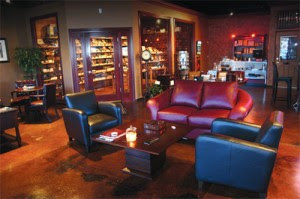
Besides the smoke-selection room, Executive Cigars also features a lounge area behind it with flat-screen TVs, leather couches and chairs and a bar. Drinks are not sold, but are available to members who bring their own bottles and also contribute to a drink fund.

Memberships range from $30 to $75 a month, Lee says.

There also is a party room upstairs that was the site of a Super Bowl get-together and is a spill-over site when the lounge gets full. It still is developing, but already is decorated and furnished.

Lee says one of the more unusual aspects of the shop is its late-night nature. He says its unofficial motto is “Your late-night cigar store,” and is generally open at least until 1 a.m.

Twitter Delicious Facebook Digg Stumbleupon Favorites More

 
Powered by Blogger