Showing posts with label smokers. Show all posts

Tuesday, July 19, 2011

Cigarette Consumption Down in Turkey


cheap winston cigarettes onlineAccording to figures by the TAPDK, the amount consumed in 2010 decreased to 93.5 billion Winston cigarettes and the figure was 107.5 billion in 2009.

Consumption of cigarettes decreased by 15 percent in 2010 compared to 2009 in Turkey. According to figures by the Tobacco and Alcohol Market Regulatory Authority (TAPDK), the amount consumed in 2010 decreased to 93.5 billion cigarettes and the figure was 107.5 billion in 2009.

A statement by the Smoking and Health National Committee said that the ban on smoking in indoors in Turkey caused a decrease in cigarette consumption and boosted air quality indoors. In the last five years, Turkish smokers consumed 524 billion cigarettes.

Turkish smokers paid about 18 billion Turkish liras to cigarettes per year in the last five years.

Tuesday, April 12, 2011

Japan Tobacco Staggers Back Following Quake

Japan TobaccoSENDAI, Japan—As shops slowly reopen along Japan’s tsunami-hit northeastern coast, many residents still aren’t finding one of the Japan markproducts they crave most: cigarettes.

The shortages represent the latest supply-chain breakdown in Japan—and a headache for Japan Tobacco Inc., which for decades has dominated Japan’s tobacco market.

The March 11 earthquake and tsunami knocked out two of Japan Tobacco’s six cigarette-making factories, damaged its distribution network and wrecked some of its suppliers’ facilities.

Japan Tobacco was forced to halt deliveries across the whole country for 12 days starting March 30. Although it said it expects to restart deliveries of seven top brands on Monday, the move cut supplies to millions of smokers, forcing even the company’s most loyal customers to try cigarettes from international rivals British American Tobacco PLC and Philip Morris International Inc.

Most of the Japanese company’s other 97 products won’t be available for weeks, if not months. The company said it aims to restart deliveries of up to 25 products over the coming month and return to normal supply volume capacity by the end of June.

Japan Tobacco’s ability to restore full capacity quickly could determine whether it can hold on to its 65% share of the $40 billion Japanese cigarette market, analysts and people in the industry said. “This could change the market and put the imported brands on top” for the first time, said Yasuhide Kitagawa, whose family runs Sendai’s Panda drug store, which specializes in foreign brands and markets BAT brands heavily. “We want that to happen.”

Taizo Demura, an analyst at Morgan Stanley MUFG Research Japan, estimated that Japan Tobacco would lose one to six percentage points in market share. “Some consumers will change,” he said. “They will try Kent, Lark, Virginia Slims or Marlboro as a trial and if they think it is better than JT, then they will stay.”

In addition to losing two of its factories, a Japan Tobacco distribution center in Sendai was damaged. The company also has had problems getting such supplies as the cardboard for cartons, the fluff in cigarette filters and the plastic film used to wrap packages, said Hideyuki Yamamoto, general manager of media and investor relations for Japan Tobacco. Among the first seven brands of which Japan Tobacco will resume distribution this week: Seven Stars, Mild Seven and Caster.

The struggle to deliver cigarettes is the latest bit of bad news for the industry in Japan. Like many countries, it has been ratcheting up taxes and restrictions, and the percentage of Japanese people who smoke slid to 25% in 2009 from 33% in 2000, according to Japan Tobacco.

While delivery of foreign brands in Japan’s northeast also was interrupted by damage to distribution centers, output was unaffected because those companies’ cigarettes are made outside the country. Foreign companies aren’t allowed to make cigarettes in Japan. Even though the foreign companies largely have resolved their distribution problems, domestic and foreign cigarettes brands alike have been hoarded by smokers worried over consistent supplies.

Smokers in Sendai exchanged tips on which stores still had supplies. Some smokers had friends and relatives courier cartons from other parts of Japan. Men took drags on the long, thin cigarettes that are marketed to women. One shop had a five-page list of orders.

Loft tobacco shop, which was the last supplier in its neighborhood, had only international cigarettes. “JT Sold Out,” said a hand-written sign on its window. “I will smoke whatever they have,” said Aika Ono as she stood in the long line in front of the store.

BAT and Philip Morris said they don’t intend to take advantage of Japan Tobacco’s situation. But they are increasing shipments to the country to meet customer demand. BAT has doubled its inventory to about four billion cigarettes. It has even airlifted cigarettes and routed supplies through Kobe to avoid bottlenecks in Tokyo.

Still, some analysts and investors projected that Japan Tobacco will offer its full portfolio within months. And some customers may feel it is their duty to switch to one of the few available Japan Tobacco brands rather than to foreign labels.

“While it is not as patriotic a mood as the ‘Buy America’ sentiment in the wake of 9/11, there could be a Buy Japan’ movement among smokers after the 3/11 earthquake,” said Chris Redl, chief investment adviser of Siena Capital, a Japan-dedicated hedge fund.

Monday, March 28, 2011

Smoking Laws Regulate Tobacco Sales

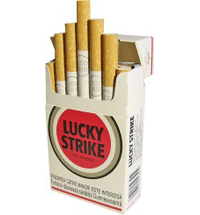
Cheap Lucky strike cigarettesBy-laws which could regulate the sale of Lucky Strike cigarettes in shops near schools, ban smoking in some indoor areas and decide which shisha cafes are licensed, are to be voted on by the Health Council early next month.

The laws, which should have come into effect by the end of last year, will clarify the enforcement of federal anti-tobacco law No 15, issued in early 2009 by Sheikh Khalifa bin Zayed, President of the UAE.

Dr. Wedad al Maidoor, the head of the National Tobacco Control Committee, said the by-laws were pending official approval because further steps had to be taken before smoking bans take effect in coming months.

The delay in drafting the by-laws was unavoidable, said Dr al Maidoor. “We have been in continuous meetings with all the concerned authorities and all the partners who must be included in drafting the by-laws, trying to find the best solutions,” she said. “We are almost done and in the final phase.”

Government departments involved in submitting proposals on what rules and regulations the law should address include the Ministry of Health, the various health authorities, Civil Defence, the municipalities and the Ministry of Economy.

Dr al Maidoor did not expect concerns or complaints about the by-laws to be lodged. That had already been dealt with, she said.

“The Health Council has to approve all laws. If the by-laws do not meet with opposition, the by-laws continue on to the Federal National Council. Within a few months, we can finalise this and start enforcing the laws,” she said.

Salem bin Mesmar, the assistant director general for the environment, health and safety control sector at Dubai Municipality, said smoking was a global crisis that needed immediate action.

Drafting the by-laws, he said, “was not an easy task”. “The Ministry of Health wants smoking all over UAE to be regulated and this law needs an appendix which explains the law in more detail and highlights the technical requirements.”

The details that had to be ironed out related to smoking, tobacco and packaging, he said.

“All over the world there is an increase of smokers, especially in the Third World and the Middle East – even in young people – and one reason for this is because companies invest heavily on advertisements,” Mr Mesmar said.

This month, Britain announced plans to enforce strict laws banning the display of cigarette packages behind cash counters from April 2012 in large shops and by 2015 for all others. The UK government aims to change social behaviour by considering a push for unbranded, plain packages.

Mr Mesmar said similar laws could come into force in the UAE. “The new rule on box advertising is coming here and we will deal with it on a GCC level,” he said.

“We would like to see the advertising on the box drop down to zero.”

In 2007, the Dubai Government approached the municipality to regulate smoking in shopping malls. Following discussions with the Shopping Mall Council, Dubai Festival City became the first smoke-free mall in the city.

“For phase two, we regulated smoking in hotels while working with the Dubai Tourism Authority. In phase three, we concentrated on cafes and restaurants, where we started with shisha, because the Government did not like it expanding,” said Mr Mesmar.

Business owners were given one year to follow the rules, but due to the financial crisis, cases were sometimes reviewed separately under special circumstances.

“Some smokers use the excuse for continuing the habit that there is too much pressure in the world and they believe it offers stress relief. Believe me, nobody who truly understands its effects will smoke.”

Dr al Maidoor said a large part of the drafted by-laws were concerned with enforcement, so that the burden was divided equally between government and private departments.

“Really, the law as it stands is quite clear and everyone should be enforcing it already. They definitely will once it is official – printed in the official gazette.”

The World Health Organisation reports that in addition to the five million people who die annually from smoking – six every second – at least 600,000 more die from second-hand, passive smoking

Twitter Delicious Facebook Digg Stumbleupon Favorites More

 
Powered by Blogger