Showing posts with label cheapest cigarettes. Show all posts

Tuesday, July 19, 2011

Cigarette Consumption Down in Turkey


cheap winston cigarettes onlineAccording to figures by the TAPDK, the amount consumed in 2010 decreased to 93.5 billion Winston cigarettes and the figure was 107.5 billion in 2009.

Consumption of cigarettes decreased by 15 percent in 2010 compared to 2009 in Turkey. According to figures by the Tobacco and Alcohol Market Regulatory Authority (TAPDK), the amount consumed in 2010 decreased to 93.5 billion cigarettes and the figure was 107.5 billion in 2009.

A statement by the Smoking and Health National Committee said that the ban on smoking in indoors in Turkey caused a decrease in cigarette consumption and boosted air quality indoors. In the last five years, Turkish smokers consumed 524 billion cigarettes.

Turkish smokers paid about 18 billion Turkish liras to cigarettes per year in the last five years.

Monday, July 11, 2011

New Measure Targets Small Tobacco Firms

best parliament cigarettes onlineA proposed Missouri ballot measure poses the question: Should a $1 per pack tax be imposed on cigarettes made “by certain tobacco product manufacturers?” Left unsaid is that the tax would not apply to the biggest tobacco companies, which sell the majority of cigarettes. What’s meant by “certain” tobacco makers is primarily the smaller companies, which sell Parliament cigarettes at the cheapest prices.

Although it’s dubbed the “Healthy Missouri Initiative Petition,” the measure appears to come not from health care groups but from large tobacco companies, which have been losing market share to upstart companies that were not part of the 1998 settlement among big tobacco firms and attorneys general in 46 states.

The proposal highlights the extent to which tobacco companies are willing to battle in Missouri, which has the nation’s lowest cigarette tax and one of the nation’s highest adult smoking rates.

The 1998 settlement calls for participating tobacco companies to pay more than $200 billion over 25 years to states. Laws enacted in those states also require companies that did not participate in the settlement to pay money into escrow funds based on the amount of cigarettes they sell. Those escrow accounts are intended to cover any future lawsuits against the companies and prevent them from enjoying significant price advantages that cut into the market share of big tobacco companies.

Yet the large tobacco companies — and many state attorneys general — contend those escrow laws left a loophole that requires states to refund any money that exceeds that state’s percentage share of the national settlement with the big companies. The result is that some smaller tobacco companies are refunded almost every dollar they put into the escrow fund — negating the financial strain that otherwise could have caused them to charge more for their product.

Despite the lobbying efforts of big tobacco companies, Missouri remains the only state in the 1998 settlement that has not subsequently passed legislation cutting those escrow refunds to smaller companies.

The battle between big and little tobacco companies matters to states because it affects their already strained budgets. When large tobacco companies lose market share, they can argue that states have failed to adequately seek payments from the companies that didn’t participate in the settlement. In such scenarios, the settlement agreement allows big tobacco companies to reduce their annual payments to states. The Wall Street Journal reported last week that big cigarette companies could recoup up to $2 billion under a proposed deal with state attorneys general related to the growing market share of companies that aren’t part of the settlement.

Having failed to change Missouri’s tobacco escrow law, the proposed ballot measure appears to be an alternative way for big tobacco companies to cut into the profits of their smaller rivals by imposing a tax that only affects companies who are not parties to the national settlement. An estimate by the state auditor’s office says the tax could raise $20 million to $100 million annually, which the initiative earmarks for programs that discourage tobacco use and for the attorney general’s enforcement efforts of the settlement agreement.

Tobacco companies that did not participate in the settlement contend it’s unfair to make them pay them — either to an escrow fund or through higher taxes — for the deceptive marketing campaigns conducted years ago by big tobacco companies.

Keith Burdick, managing partner of Xcaliber International Ltd based in Pryor, Okla., notes that his cigarette company didn’t get started until 2001, a few years after the settlement. To make his company pay into an escrow fund is like a city requiring motorists who are merely passing through to pay $50 to City Hall in case they do something wrong the next time they drive through town, Burdick said. The Missouri ballot proposal is equally wrong, he said.

“We don’t see it as really fair — you tax one group and not the other,” Burdick said. “It’s got Altria’s name written all over it.”

A spokesman for Altria Group, the nation’s leading cigarette maker, declined to comment about whether the company sponsored or supports the Missouri ballot proposal. A spokesman for Reynolds American Inc., another top cigarette maker, did not return repeated phone calls or emails seeking comment.

The ballot initiative was filed by Jefferson City attorney Marc Ellinger, who in 2006 represented a group funded primarily by Reynolds that opposed an 80-cent per pack tax increase for all brands of cigarettes. That measure was narrowly defeated by voters.

Ellinger said his client had forbidden him from revealing its identity or discussing the current initiative.

It remains to be seen whether the initiative’s secretive sponsor actually will attempt to collect petition signatures to qualify for the 2012 ballot. The initiative was filed with the secretary of state’s office a day before the end of this year’s legislative session — suggesting its main purpose may be to put pressure on legislators to pass a law targeting the tobacco companies that weren’t part of the settlement.

Political consultant John Hancock, who worked on behalf of the failed 2006 ballot initiative, now is coordinating a group called Citizens to Stamp Out Cheap Cigarettes. He says the group has no financing and did not initiate the latest ballot proposal, though it does support it.

“Having the cheapest cigarettes in America is not something to be proud of,” Hancock said. “This approach is one of a number of mechanisms to address that concern.”

Monday, June 20, 2011

A puff of flavor: Cigar talk

With Father’s Day approaching, it might be a good time to help dad indulge in the time-honored experience of puffing on an expertly rolled cigar. While popular sentiment and government bans sometimes make it necessary to take pains to enjoy a good smoke, the experience can still be rewarding.

Consider the quiet joy that can be found during a long walk down a country road alone, save for one’s favorite cigar. Don’t know enough about cigars to feel confident buying them? The Capital District shops noted here have friendly, knowledgeable staffers ready to help shoppers make the right choice, no matter what their level of tobacco knowledge.

Selecting the right cigar

“Cigar-smoking is highly individual and subjective,” says Scott Bendett, founder and proprietor of Habana Premium Cigar Shoppe in Albany. “It’s a matter of taste.”

If you don’t know what you’re looking for, Bendett or a staff member can make suggestions. Habana Premium features numerous brands, a walk-in humidor and cigars flavored with vanilla, rum, cappuccino, honey and mandarin.

“We love talking with gift shoppers to help them make a good selection,” says Rich Albers, assistant manager at Park Lane Tobacconist in Clifton Park. “There’s no reason to feel intimidated.”

According to Albers, things to consider include how long the person has been smoking; if they prefer a mild or robust cigar, in a large or small size; and if they have a brand preference.

“The occasional smoker generally wants a milder cigar,” says John Zyniecki, coproprietor of EdLeez Tobacco in Albany. “The regular smoker usually likes a more flavorful cigar.”

When buying cigars for a special occasion, Zyniecki says most shoppers choose a “limited cigar,” such as an Opus X. Ranging in price from $15 to $20 per cigar, these are typically the items most smokers appreciate but do not regularly buy for themselves and are made in limited quantities. Brands such as Ashton, Arturo Fuente, CAO, Camacho, Davidoff, Cusano and Macanudo also make high-end cigars.

Cigar talk

The cigar world has a vocabulary all its own, and a good tobacconist should be able to explain the points of a cigar’s three main components: wrapper, filler and binder. While some machine-made cigars are very good, the handmade versions will always be the most sought-after among cigar cognoscenti. Master blenders use leaves from different regions, harvests and countries to create flavors and other characteristics for various tastes.

“A handmade cigar is based on the blender’s experience,” Bendett says. “It’s a work of art.”

A cigar’s wrapper or outer covering is made from a tobacco leaf that’s often different from the filler and binder, and provides most of its flavor. With cigars, appearances matter and can provide the first clues as to what may be in store for a smoker. Wrapper color can range from light tan (claro) to an almost black-brown (maduro), with many variations. Wrapper color however, should be rich, even and smooth with a slight shine from the oil that naturally occurs in the leaf. This is usually more obvious on cigars with darker wrappers.

When examining a box of cigars, color should be consistent. Wrappers should also be free of leaf veins, cracks or tears.

Filler makes up the majority of the cigar’s interior, and the best come from Honduras, the Dominican Republic and Nicaragua. Long-filler cigars demand a premium over medium- and short-filled versions. Long-filler cigars “burn” more smoothly and must be puffed to keep from going out. Short-filler cigars burn quickly, as the tobacco length resembles that found in cheapest cigarettes.

Once filler is shaped and blended, the binder is added and the cigar is rolled. It is then put into a mold until ready to be wrapped. Usually the thicker tops of the tobacco plant are used as binder, with the better ones coming from Cuba, Connecticut, Mexico and Ecuador. Recently, Java and Sumatra binders have become sought-after, as they’re durable and flexible.

A cigar with a light-colored outer wrapper typically means it will be mild. Terms used to describe cigars are difficult to define because they often mean different things to different people. “Mild” to one smoker may translate as “weak” to another. While some seek a “robust” or “full-bodied” cigar, others may find such traits “overpowering.”

Shape of things to come

The variation on cigar size is almost limitless. The most popular shapes are robusto, toro and Churchill.

Cigars are measured by length and width. Length is done in inches; width is measured in ring gauges. One ring is 1/64th of an inch.

A typical robusto is a 50-ring gauge and 5 inches in length. A manufacturer may create a “gran robusto,” which will be longer or wider. A toro reaches 6 inches and is usually a 50-ring gauge. Churchills are narrower at 48-ring gauge, but stretch to 7 or 71/4 inches in length. Other popular sizes include corona (the larger version of robusto), panetela (a long, thin cigar) and lonsdale (longer than corona, but shorter than panetela). One manufacturer’s petit corona will probably overlap with another’s robusto. The “torpedo” is slightly irregular in composition, about 6 inches long, pointed at one end and a bit fatter in its center (about 54-ring gauge).

While many cigar makers boast “Cuban seed tobacco” as an ingredient, it is difficult to verify, and most smokers agree better tobacco now comes from the Dominican Republic. “Tobacco is a product of the soil and other agricultural conditions,” notes Bendett. “Dominican agricultural practices and conditions enable tobacco to age better and retain its flavors very well.”

Dominican tobacco typically starts off mild, but builds in intensity as smoked. The taste tends to hit the entire palate and stimulate all receptors in the smoker’s mouth while the aroma can be sweet and floral. Nicaraguan soil is low in acid and produces a harsher tobacco. Cuban products are illegal in the united States.

“Lots of customers compare the costs of cigars with prices offered by Internet merchants,” says Bendett. “This is especially true for New York smokers, because we live in a high-tax state for tobacco products. With Internet purchases, you have no knowledgeable guide and can’t get a sense of the cigars’ condition. You have no idea how they’ve been stored or handled.”

Most cigar shops also sell other merchandise that can make good gifts, such as cutters, humidors, cases, lighters, pipes, pipe tobacco and high-end cigarettes.

Joseph Finora is a freelance writer in Laurel (Suffolk County).

Where to buy
EdLeez Tobacco, Stuvesant Plaza, Guilderland, 489-6872
Habana Premium Cigar Shop, 1645 Central Ave., Albany, 690-2222
James & Sons Tobacconists, 360 Broadway, Saratoga Springs, 581-7274
Park Lane Tobacconist, 15 Park Ave., Clifton Park, 371-6274

Thursday, April 14, 2011

Smoking allowed: Cigar bars offer a safe haven

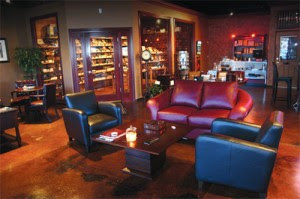
Cigars allowedSometimes a cigar is just a cigar. But finding a place to enjoy it? Good luck with that, pal. Yet, there are still dens of iniquity where the words “smoking” and “allowed” are linked, when a guy or girl can fire up their choice of legal intoxicant from Honduras or the Dominican Republic. Smoking a cigar is a ritual, a way to slow down. And it keeps both hands busy, so the devil can’t find work for them. Here, we offer a round-up of safehouses where you can light up without censure.

From the outside, Executive Cigars in the North Side looks like a neighborhood smoke shop that would specialize in those commercial cigars sold in small cardboard boxes.

Don’t be fooled.

The two-year-old store run by Andrew Lee is home to a sealed room filled with floor-to-ceiling racks of cigars ranging from $5 to $30 each. They represent offerings from companies such as Oliva and offer a great variety of cigar types, tastes and sizes.

Lee tries to offer a cigar education to his customers, insisting “if you know the rules of math you can solve any problem. If you are going to smoke cigars you have to know the rules.”

The shop may have an urban appearance, but customers talk about its range of clients, from neighbors to young professionals on their way home to the suburbs.

Besides the smoke-selection room, Executive Cigars also features a lounge area behind it with flat-screen TVs, leather couches and chairs and a bar. Drinks are not sold, but are available to members who bring their own bottles and also contribute to a drink fund.

Memberships range from $30 to $75 a month, Lee says.

There also is a party room upstairs that was the site of a Super Bowl get-together and is a spill-over site when the lounge gets full. It still is developing, but already is decorated and furnished.

Lee says one of the more unusual aspects of the shop is its late-night nature. He says its unofficial motto is “Your late-night cigar store,” and is generally open at least until 1 a.m.

Wednesday, March 23, 2011

Philip Morris set grow market share in Armenia tobacco market

Philip Morris International and Armenia

Last year Armenian government approved several regulations to control local tobacco market and major tobacco companies. Regional senior manager of Philip Morris International, the leading tobacco group in Armenia, Sargis Tsaghikyan stated that the tobacco giant is set to show another great performance capturing more market share in 2011.

Mr. Tsaghikyan said that Philip Morris Armenia offers solid and balanced brand portfolio in the local market, and is presented in all price categories, keeping in touch with all adult costumers’ needs. This makes the company believe that its business performance will be successful and the market share will continue to grow.

According to PMI Armenia is an emerging and very competitive market. And the Marlboro-maker has a 19.5 percent share of that market, the biggest among its major rivals.

In 2010 Philip Morris International offered the following brands to the Armenian smokers: Marlboro, L&M, Parliament, Chesterfield, Virginia Slims, Bond Street, Muratti Ambassador, Red&White and Assos Slims. L&M is the best-selling brand among PMI brands.

Last October, Armenian president signed into law amended Excise Tax Law and Tobacco Products Tax Law under which the tax rate difference among imported and locally manufactured tobacco products will be gradually reduced starting from Jan 1st 2011, therefore introducing equal approach to local and imported cheapest cigarettes. Philip Morris International welcomed these tax code amendments, as they are implemented in established time and prompt Armenian Tobacco Products Taxation equaling with World Trade Organization requirements.

Armenia adopted a universal and thorough legislative base to regulate tobacco industry and according to Philip Morris Armenia senior manager, the company is willing to cooperate with the government and public health authorities to establish norms and regulations for the domestic tobacco industry. The company believes it is vital that regulatory base is comprehensive, justified by evidence and covering all tobacco companies and products and that enforcement is adequate and even. These regulations could allow the authorities reach the public health objectives.

Philip Morris International is the largest international tobacco group in the world, selling its products in more than 160 markets. In 2009 the company had an approximately 15.4 percent share of global cigarette market excluding the United States, or 26 percent, excluding China and the USA.

On its official website, PMI states that smoking can cause addiction and severe health complications and recognizes that there is no safe form of tobacco consumption. The company supports strict and effective measure to regulate tobacco, and agrees that cessation should be the major aim of public health policies. At the same time Philip Morris International doesn’t target non-smokers and minors, and their marketing strategies are intended to adult smokers and set to encourage them top prefer PMI’s brands in favor of competitors’ products.

Monday, March 21, 2011

New Candy Flavored Tobacco Products become popular among Teens

Tobacco cigarette smokingOLYMPIA ¾ More Washington students are making healthier choices by avoiding alcohol according to a recent survey of kids in our teensmokingstate. But declines in cigarette smoking continue to stall and an increase in new candy-flavored tobacco products is a growing concern.

The Healthy Youth Survey is anonymous and voluntary; it’s taken every two years by thousands of Washington students in grades 6, 8, 10, and 12 in more than 1,000 public schools. It focuses on attitudes and health risk behaviors. Topics include drug, alcohol, and tobacco use; gangs; physical activity; suicide; bullying; and more. For the first time, the survey also asked about sexual activity.

“It takes a consistent, coordinated effort to make the healthy choice the easy choice for our kids,” said Secretary of Health Mary Selecky. “This survey shows that some of that hard work is paying off and kids are making better choices to improve their health. Of course there are always new generations of kids to reach so the work never ends.”

Since 2000, youth cigarette smoking has dropped by half, resulting in about 70,000 fewer smokers. However, these dramatic reductions have slowed in recent years, with 10th grade smoking remaining mostly flat at about 13 percent from 2004 to 2010. Besides cheapest cigarettes, youth are using other tobacco products that are often flavored to taste like candy. Among youth who use tobacco, about half report using some type of candy-flavored product. Chewing tobacco use by 10th graders is on the rise, particularly among girls — the rate has more than doubled in the past 10 years to more than three percent.

In the past 20 years, there’s been a big drop in 8th and 10th graders who report drinking alcohol in the past 30 days. Since 1990, youth drinking is down for 8th graders by over half, from 29 to 14 percent in 2010. Drinking among 10th graders has dropped from 44 to 28 percent. Since 2008, about 20,000 more youth in 8th, 10th, and 12th grade report that their parents talked to them about not drinking alcohol.

“Underage drinking is a major health concern in Washington,” said Liquor Control Board Chair Sharon Foster. “I’m pleased the most recent survey shows a continued downward trend. Statewide efforts the past few years have encouraged parents to talk to their kids about alcohol, because studies show parents are the number one influence on whether teens choose to drink.”

“It’s great news that our collective work in educating parents and kids is paying off,” said Department of Social and Health Services Secretary Susan N. Dreyfus. “When parents and other caring adults talk with and monitor the children in their lives, those children are more likely to succeed in school, stay healthy, and avoid addiction and other problems related to using alcohol or other drugs.”

Alcohol is the primary drug of abuse among youth, but the numbers are declining. Since 2008, there are about 11,000 fewer youth drinking alcohol. The message about the risks of prescription drug abuse is starting to get out there — pain medicine abuse is down among 12th graders.

There’s also more work to do in other areas. When students are depressed, abuse substances, are bullied and feel unsafe at school, they’re less likely to succeed academically. About seven percent of 10th graders attempted suicide in the past year — down from the previous survey. Of 10th graders surveyed in 2010, 85 percent said they felt safe at school.

“Teachers and school administrators have made progress in creating safe and supportive learning environments for our students,” said Superintendent of Public Instruction Randy Dorn. “More of them report they feel safe, enjoy being at school, and have opportunities to become involved in school-related activities. We know when students are engaged in their learning experience and feel safe, they’re more likely to succeed academically.”

About 31 percent of 10th graders and 53 percent of 12th graders in the state reported having ever had sexual intercourse. About eight percent of 10th graders and 17 percent of 12th graders reported they had four or more sexual partners. Among those who had ever had sexual intercourse, about 63 percent of 10th graders and 54 percent of 12th graders reported using a condom the last time they had intercourse.

The survey is a joint effort of the Department of Health, Department of Social and Health Services, Office of Superintendent of Public Instruction, Liquor Control Board, the Family Policy Council, and the Department of Commerce.

Twitter Delicious Facebook Digg Stumbleupon Favorites More

 
Powered by Blogger